
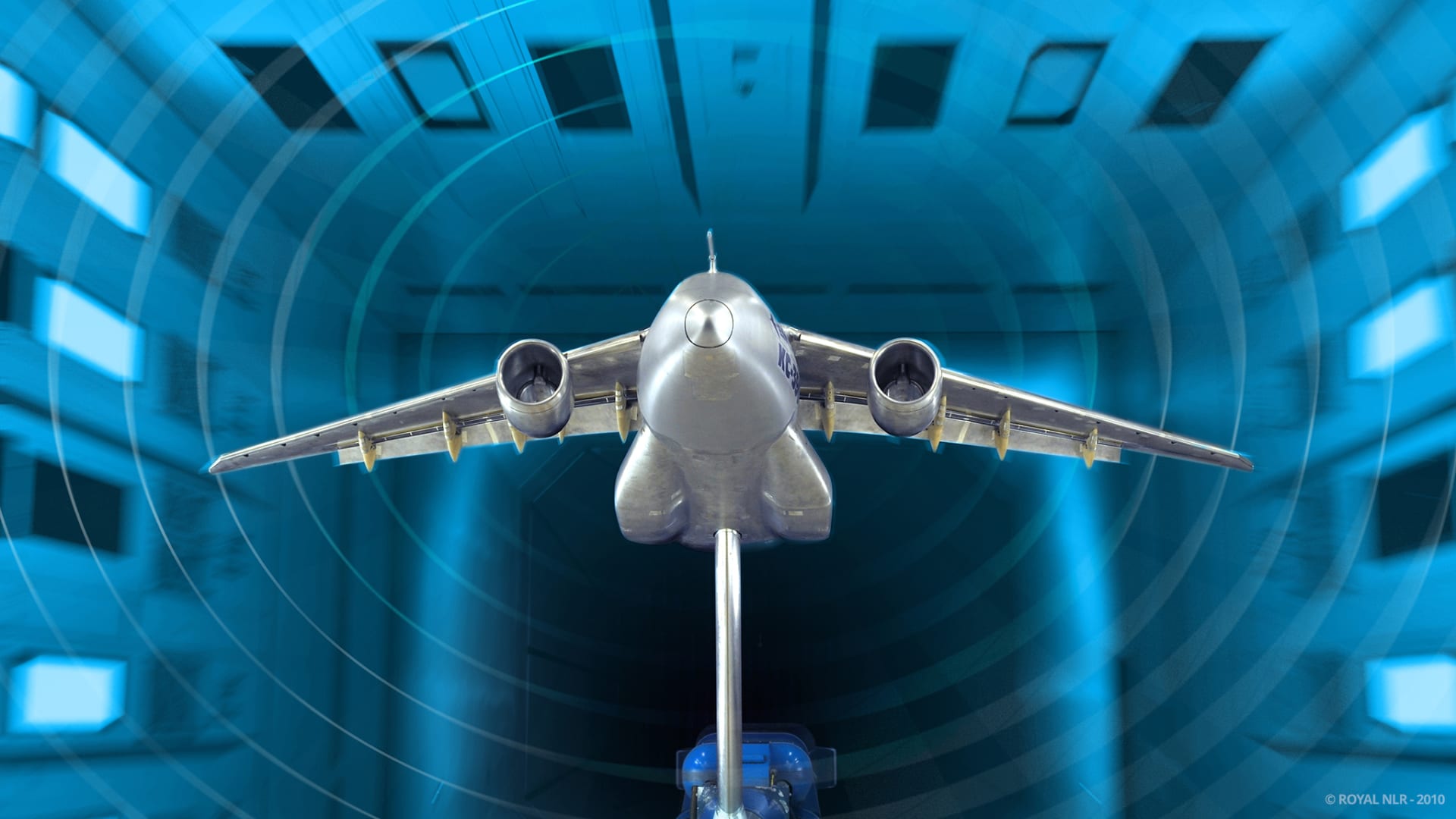
Graduation Internship: Prediction and Analysis of Interaction Noise in Lift-Plus-Cruise Small UAS
- Op locatie
- Marknesse, Flevoland, Nederland
- Aerospace Vehicles
Functieomschrijving
Background
Aeroacoustic noise generated by aerodynamic interaction effects is a dominant contributor to the noise signature of lift-plus-cruise small unmanned aerial systems (sUAS), particularly in the mid-frequency range. In such configurations, complex interactions between rotors, wings, fuselage, and other lifting surfaces lead to pronounced tonal components associated with blade-passing frequencies and their harmonics. In addition broadband noise can play a significant role. These interaction-driven noise mechanisms are especially relevant during transitional flight regimes, where multiple propulsive and lifting elements operate simultaneously.
Accurate prediction of both tonal and broadband components remains challenging due to unsteady inflow conditions, wake–airframe interactions, and non-uniform aerodynamic loading effects, particularly at sUAS scales. Comprehensive rotorcraft analysis tools, such as FLIGHTLAB (FLAT), provide physics-based frameworks capable of capturing unsteady aerodynamic interactions, while research-oriented aeroacoustic tools developed at TU Delft (e.g., the LOPNOR model) offer dedicated capabilities for predicting tonal noise generation and propagation.
However, the relative performance, required modeling fidelity, and consistency of these complementary approaches have not yet been systematically benchmarked against high-quality wind-tunnel aeroacoustic measurements for lift-plus-cruise sUAS configurations. A coordinated validation effort is therefore essential to assess predictive capability, identify model limitations, and improve confidence in noise predictions.
Assignment
The aim of the assignment is to investigate, predict, and validate aeroacoustic noise generated by aerodynamic interaction effects in lift-plus-cruise sUAS configurations by benchmarking FLAT and LOPNOR model predictions against wind-tunnel aeroacoustic measurements.
Objectives
Identify and characterize dominant tonal and broadband noise mechanisms arising from rotor–airframe and rotor–rotor aerodynamic interactions in lift-plus-cruise sUAS configurations.
Analyze tonal noise signatures in the mid-frequency range, with emphasis on blade-passing frequencies and harmonic content.
Apply comprehensive rotorcraft analysis methods (FLAT) to model unsteady aerodynamic loading and interaction effects.
Apply and assess the LOPNOR noise prediction tool developed at TU Delft for the same configurations and operating conditions.
Benchmark and compare FLAT- and LOPNOR-based tonal- and broadband noise predictions against available wind-tunnel aeroacoustic measurements.
Quantify prediction accuracy, identify dominant sources of discrepancy, and assess the modeling fidelity required for reliable noise prediction.
Methodology
Review literature on tonal and broadband noise generation mechanisms related to rotor–airframe and rotor–rotor interaction effects.
Analyze wind-tunnel aeroacoustic measurements of a representative lift-plus-cruise sUAS to extract dominant tonal and broadband features and interaction-related signatures.
Perform comprehensive rotorcraft simulations using FLAT to obtain unsteady aerodynamic loading in relevant flight and transition conditions.
Use aerodynamic and operational inputs to generate noise predictions using the LOPNOR model.
Compare predicted and measured tonal spectra, focusing on mid-frequency content, blade-passing tones, and harmonic structure.
Conduct sensitivity studies to assess the influence of modeling assumptions, interaction fidelity, and operating conditions on tonal noise predictions.
Result
Advancements in the understanding and prediction of the aero-acoustic interactions occurring on lift-plus-cruise aircraft configurations in hover, transition and forward flight.
Insights into mid-frequency range far-field tonal and broadband noise contributions of a lift-plus-cruise aircraft in various flight configurations.
Duration
Minimum 6 months, starting as soon as possible.
Profile
Master student Aerospace Engineering, preferably background in aerodynamics
Experience with aeroacoustics and unsteady aerodynamics, MATLAB/Python programming (experience with Fortran, C, or C++ is a plus), and frequency-domain signal processing
Familiarity with comprehensive rotorcraft analysis tools (e.g., FLIGHTLAB/FLAT), noise prediction models (e.g., LOPNOR), and wind-tunnel aeroacoustic measurements is highly desirable.
Prior exposure to CFD or rotorcraft aerodynamics is an advantage.
Assertive & self-motivated, able to be part of the project team and also proceed individually
What we offer
A challenging graduation project in a high-tech result orientated work environment
Weekly supervision and availability of the technical staff for support
An internship allowance
Compensation for double living expenses in case of temporary relocation
Working in an actual R&D project as part of the team
Internship results to be used in the current and future projects
About NLR
Royal NLR has been the ambitious research organisation with the will to keep innovating for over 100 years. With that drive, we make the world of transportation safer, more sustainable, more efficient and more effective. We are on the threshold of breakthrough innovations. Plans and ideas start to move when these are fed with the right energy. Over 800 driven professionals work on research and innovation. From aircraft engineers to psychologists and from mathematicians to application experts.
Our colleagues are happy to tell you what it’s like to work at NLR.
This assignment will be managed by the Aeroacoustics & Experimental Aerodynamics group within the Aerospace Vehicles Vertical Flight and Aeroacoustics (AVVA) department.
Interested?
Contact us for more information or send your application, together with your motivation letter and CV, to Dr. Ir. Remco Habing at Remco.Habing@nlr.nl and Dr. Furkat Yunus at f.yunus@tudelft.nl and we will contact you as soon as possible.
of
Helemaal klaar!
Je sollicitatie is succesvol ingediend!
Je hebt al gesolliciteerd op deze vacature
We waarderen uw interesse in deze functie. Helaas heb je al gesolliciteerd op deze functie.